The Long Watch

The Long Watch

In the winter of 2047, the little town of Ash Hollow still had a church that met in the old feed store on Maple Street. Most Sundays only nine or ten people came—fewer when the wind howled off the lake and rattled the tin roof like judgment itself.

Elias Crowe was the oldest of them. Eighty-three, wiry, hands still calloused from decades of turning wrenches on fishing boats. He never preached; he simply read. Every week he chose one passage, always from the same worn black Bible with the cracked spine, and read it slowly, as though each word needed time to settle into the bones of the listeners.

This particular January morning the sky was the color of wet concrete. Snow had stopped falling, but the cold kept everything locked in place. Elias opened to 2 Peter 3 and began.

When he reached verse 4—“They will say, ‘What happened to the promise that Jesus is coming again? From before the times of our ancestors, everything has remained the same…’”—a young man in the back row snorted softly.

Micah Tate was twenty-six, home from Cleveland because the factory had closed again. He’d come mostly because his grandmother insisted, and because there was nowhere else warm to be on a Sunday morning. He wore a faded hoodie and the permanent half-smile of someone who had already decided the world was a joke being told too slowly.

After the reading, coffee was poured, Styrofoam cups steamed. Micah stayed behind while the others shuffled out into the white.

“You really believe that?” he asked Elias, nodding toward the open Bible. “Two thousand years. Nothing. Not one sign. And we’re still supposed to act like the sky’s about to crack open tomorrow?”

Elias stirred sugar into his coffee with deliberate turns of the plastic spoon. “You think nothing’s changed?”

“World’s still here. Sun comes up. People still cheat, love, die, post stupid videos. Same as always.”

The old man looked out the frost-laced window. “You know what my father used to say about the flood?”

Micah shrugged.

“He said the worst part wasn’t the water rising. It was how ordinary the mornings were right up until the moment they weren’t. People fed their chickens, argued over the price of grain, planned weddings. Then one day the springs broke open and the windows of heaven opened and the thing they’d all been warned about arrived without fanfare. Just… water. And silence after.”

Micah crossed his arms. “So God’s waiting again. Playing the long game.”

“He’s not playing,” Elias said quietly. “He’s grieving. Every day He waits is another day someone gets to turn around. Every morning the sun comes up is mercy wearing work boots.”

Micah laughed once, short and dry. “You make it sound like He’s holding His breath.”

“Maybe He is.” Elias set the cup down. “But breath-holding only lasts so long. Then you either exhale… or everything changes.”

They stood in silence a while. Outside, a pickup rumbled past, chains clanking on the tires. Ordinary sound. Ordinary day.

Micah finally spoke, softer. “What do you do with all that waiting?”

Elias looked at the younger man for a long moment, then reached for his coat. “I get up. I read. I pray. I try to be kind when I’d rather be right. And I keep my eyes on the horizon—not because I think I’ll see the clouds part today, but because the One who promised is faithful even when the calendar laughs at Him.” He zipped the coat, paused at the door. “You want to know the strangest thing, Micah?”

The young man lifted an eyebrow.

“Every time I read that passage, I realize I’m not waiting for the fire or the new earth. Not really. I’m waiting for the moment I finally believe—down in my marrow—that He’s been patient with me all this time. And that’s the part that hurts the sweetest.”

Elias stepped outside into the cold. The door creaked shut behind him.

Micah stayed in the empty feed-store sanctuary a little longer, staring at the open Bible on the folding table. The page was still turned to chapter 3. The words sat there, quiet and unhurried.

Outside, snow began falling again—soft, steady, covering yesterday’s tracks like mercy wearing white gloves.

And somewhere, far beyond the gray sky, a clock that no one could read ticked on, patient, relentless, kind.


The Last Tent: A Story of the Apostle Peter

The following story is a narrative reimagining of the passage from 2 Peter 1:12-21, exploring the final days of the Apostle Peter and his urgent desire to leave a lasting legacy of truth for the early Church.

The Last Tent: A Story of the Apostle Peter

The oil lamp flickered in the corner of the small, cramped room, casting long shadows against the stone walls. Peter sat at a wooden table, his hands—calloused from decades of pulling nets and scarred from years of travel—trembling slightly as he dipped a quill into the ink. He knew his time was short. The Lord Jesus Christ had made it clear to him that he would soon "put aside" the "tent" of his earthly body.

The Burden of Remembrance

"I will always remind you of these things," he whispered to the empty room, his voice raspy but firm. He wasn't writing anything new; he was writing to refresh their memories while he still had breath. He looked at the parchment, thinking of the believers scattered across the empire. They were already "firmly established in the truth," yet Peter knew how easily the human heart could drift. He wanted to make every effort to ensure that after his "departure," they would have a permanent anchor for their faith.

Not Myths, but Majesty

Peter paused, thinking of the "cleverly devised stories" being whispered in the marketplaces—fables and myths that tried to soften the reality of the Gospel. He gripped the quill tighter.

"We did not follow stories," he wrote. He closed his eyes and was suddenly back on the sacred mountain. He could still feel the chill of the high altitude and the weight of the glory that had descended upon them. He wasn't relaying a legend; he was an eyewitness of His majesty.

He remembered the moment clearly: the air shimmering, the blinding light, and the voice that seemed to vibrate through his very bones. It was the voice of the Majestic Glory, God the Father, saying, "This is my Son, whom I love; with him I am well pleased". Peter, James, and John had heard it with their own ears.

The Light in the Dark Place

As vivid as that memory was, Peter knew the believers he was writing to needed something even more enduring than his personal experience. He pointed them toward the "prophetic message," calling it something "completely reliable".

He compared the Word of God to a light shining in a dark place. The world was growing darker, filled with uncertainty and persecution, but the scriptures were a lamp that would guide them until "the day dawns and the morning star rises in your hearts".

Carried by the Spirit

Finally, Peter addressed the origin of these holy words. He wanted to make sure they understood that the scriptures weren't just the opinions or "interpretations" of men. No prophecy ever came from "human will".

Instead, he pictured the ancient prophets like ships with their sails caught by a mighty wind. They were "human," yes, but they were "carried along by the Holy Spirit" as they spoke the words of God.

Peter finished his letter and set the quill down. He had done his part. He had passed on the light, ensuring that even after he left his earthly tent, the truth of Jesus Christ would remain unshakable for generations to come.


The Chroma-System Dystopia: A Minor Violation

The Central Allocation Hub was a cathedral of controlled light and color, a place where the Chroma-System expressed its rigid hierarchy. The air hummed with the noise of sanctioned transit, and the population moved like a carefully sorted box of components.

Kael, a tall man whose skin was the deep mahogany of the equatorial belt, wore the deep, aggressive crimson of the Enforcer Caste. Every thread of his uniform was woven with the privilege of the military family that had generated him. Red was command, swift action, and unquestionable authority. He did not walk so much as traverse, his movement deliberate, his eyes scanning for dissent or, worse, confusion. He carried the weight of his inherited color like armor.

Milo, lean and precise, a South Asian man whose spectacles caught the fluorescent light, moved nearby. His tunic was the rich, tailored emerald of the Steward Caste. Green meant ledger, liquidity, and the careful management of all resources—including the salaries that kept the Reds supplied and the lower classes pliable. Milo was rushing to secure an asset manifest for a high-priority shipment. His job was to ensure the colors balanced.

Milo clipped a corner a little too sharply near a maintenance access port, causing his secure datapad to slip from his hand and clatter onto the reinforced plasteel floor, dangerously close to Kael’s crimson boot.

Kael stopped instantly. To step over an unsanctioned object was an impurity. To acknowledge an object dropped by a Green in his direct vicinity was an irritant. Kael simply stood, radiating annoyance, waiting for Milo to retrieve his error.

“My apologies, Enforcer Kael,” Milo stammered, hurrying to retrieve the financial asset. He hated having to stoop in front of a Red; it felt like a visible admission of inferiority, even though the Green Caste held immense leverage over the infrastructure.

At that moment, the third man emerged from the narrow, semi-dark corridor labeled "Infrastructure Access."

Finn wore the uniform of the Utility Caste: a pale, non-committal Grey. Grey was the color of generalized labor, mixed blood, and the lowest rung—valued for being average at everything and specialized in nothing. He was a young Latino man, and the sleeves of his utilitarian jumpsuit were rolled up past his elbows, revealing strong, capable arms that were currently smudged with multi-purpose lubricant. He was invisible by design.

Finn’s job was to perform any task that required a body but no specific expertise. He saw the Green man struggling, the Red man judging, and the datapad—a critical asset—left exposed on the floor. Without breaking stride, and acting on pure, practical instinct, Finn bent, scooped up the datapad, and handed it to Milo.

The contact was brief, a transgression against the system's unspoken law: the Grey Caste did not touch the Green’s high-value assets, or interfere with any primary caste interaction, without express command from a Red.

Milo clutched the datapad, stunned into silence. He looked from Finn to Kael, terrified of the Red’s reaction.

Kael’s gaze was fixed on Finn. He wasn't seeing a Grey; he was seeing a kinetic efficiency that bypassed protocol—a concept alien to his inherited life.

“You exceeded your designation, Grey,” Kael stated, his voice a low, flat command, but lacking the expected immediate fury.

Finn didn't flinch. He simply wiped his hands on his Grey thigh. “It was on the floor, blocking the path, sir. The flow must be maintained.”

Finn then turned and pulled open the heavy maintenance hatch, the loud hiss of the seal breaking a deliberate distraction. He dropped back into the noisy sub-level, disappearing into the practical darkness where color didn't matter, pulling the heavy metal door shut behind him.

Milo looked at the sealed hatch, then back at Kael’s still, crimson form.

“He solved the problem, Enforcer,” Milo whispered, testing the boundaries.

Kael slowly nodded once, the movement barely perceptible. “The problem is solved. The protocol was violated. Ensure the next violation is reported immediately, Steward.” Kael continued his patrol, the crimson of his uniform a silent, dominant assertion. The system had bent, but it had not broken. It never did.


The Bug That Almost Stopped Christmas

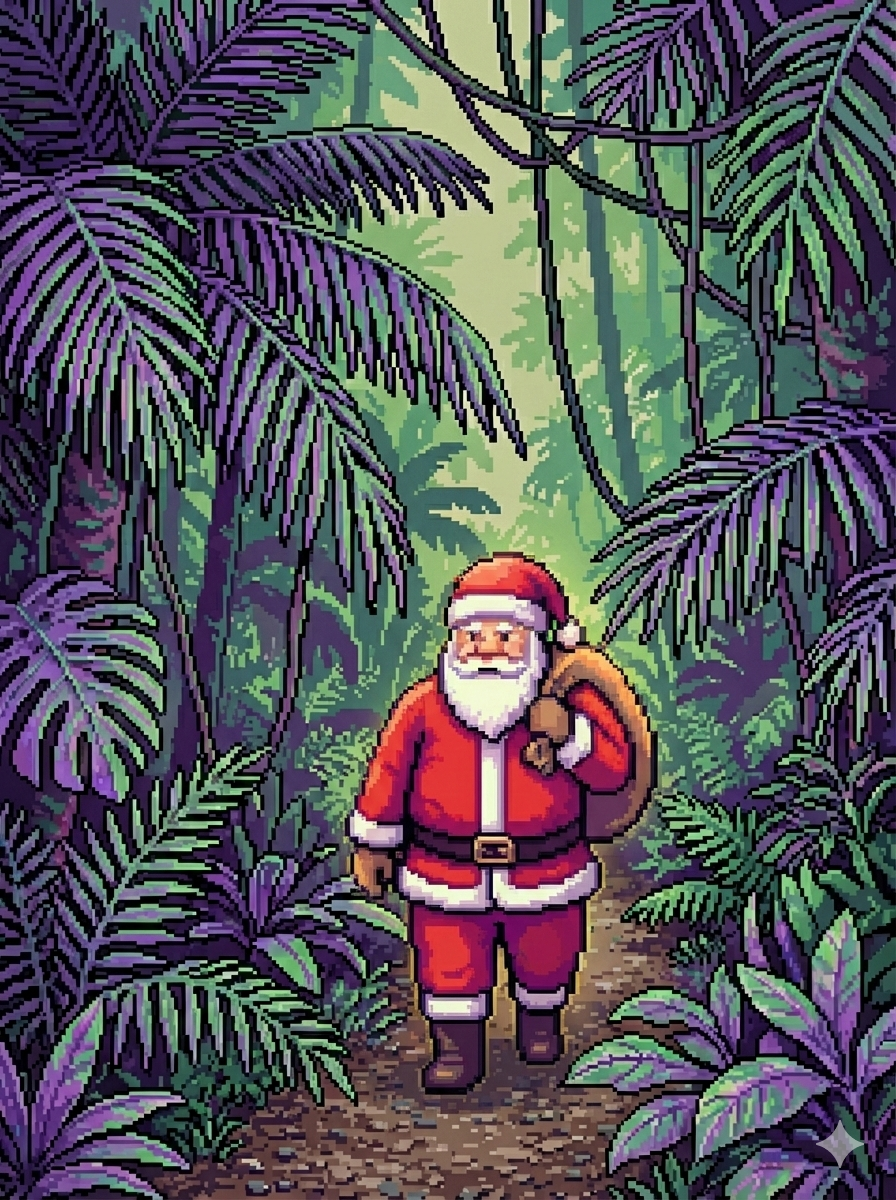
Santa in a jungle

Santa Claus was not prepared for 2020.

He had seen wars, plagues, the invention of fruitcake—nothing fazed him. But when the Council of Legendary Figures held their emergency Zoom (yes, even they had Zoom now), the news hit like a sled into a brick wall.

“Non-essential travel banned in 73% of countries,” the Easter Bunny read from his screen, ears drooping. “Physical distancing, two meters minimum. Masks mandatory. And children are doing… virtual school? Whatever that is.”

Tooth Fairy kept flickering in and out—her Wi-Fi was terrible under pillows these days.

Santa muted himself, stared at the Naughty/Nice dashboard, and watched the Nice column climb higher than ever before. Kids were stuck inside, drawing him thank-you pictures, leaving out hand sanitizer instead of cookies because “Mrs. Claus is old and we don’t want her to get sick.”

He felt something tighten in his ancient chest.

That night he called the elves into the Great Hall.

“We’re not cancelling Christmas,” he said flatly.

The head elf, Bernard, raised a cautious hand. “Sir, the sleigh’s contrail has been classified as an aerosol risk in Norway.”

Santa took off his spectacles and rubbed the bridge of his nose. “Then we adapt.”

And they did.

First, the workshop became a Level-4 biosafety lab overnight. Elves in full PPE stitched masks into the lining of every stocking. Toys were dipped in hospital-grade disinfectant that smelled faintly of peppermint. Any doll that coughed was immediately quarantined.

Second, the reindeer. Dasher tested positive for something called “reindeer norovirus” after licking a runway in Milan. They all got swapped to the B-team: Karen, Zoomer, Dave, and six others who’d been in the reserves since 1823. Rapid tests were done with candy-cane swabs.

Third, the big one: the delivery system.

No chimneys this year. Too much risk of fomite transmission.

Instead, Santa partnered with the only organization still moving faster than him: Amazon.

Jeff Bezos himself took the call.

“Nick, buddy,” Jeff said, floating in a zero-G office that definitely wasn’t on Earth, “we can drop-ship 94% of the list. But the personal touch—that’s still you.”

So they built the Bubble Sled.

It looked like a snow globe on runners: a perfect, shimmering sphere of positive pressure around Santa and the seat. HEPA filters hummed like a choir of angry bees. UV-C lights bathed everything in purple. The dashboard had a Zoom tile permanently open to Mrs. Claus, who’d become the mission control queen.

December 24th, 8:00 p.m. North Pole time.

Santa climbed in wearing a red hazmat suit trimmed in white fur, beard tucked neatly into an N95 printed with tiny reindeer. He looked like a jolly astronaut.

“Contact tracing enabled,” Bernard said, tapping keys. “If you get within six feet of anyone awake, the suit auto-ejects glitter. Highly visible. Highly embarrassing.”

Santa rolled his eyes. “I haven’t been caught since 1968. I’m not starting now.”

Liftoff was silent—no hoofbeats on rooftops, just the soft hum of anti-grav boosters (an early gift from a certain space billionaire).

First stop: Brooklyn, 2:14 a.m.

Apartment 4B. Single mom working double shifts as a nurse, asleep on the couch still in scrubs. Her seven-year-old, Amara, had asked for “anything that makes noise so the quiet isn’t so loud.”

Santa materialized on the fire escape—the Bubble Sled hovered politely outside the window like a friendly UFO. He scanned the QR code the elves had taped to the glass weeks earlier (opt-in delivery, of course). Window unlocked itself. He floated in.

The gift: a bright red karaoke microphone that projected constellations on the ceiling when you sang. He set it under the tiny tree, added a box of cookies marked “Already Sanitized—Love, Mrs. C.”

As he turned to leave, Amara stirred.

Santa froze.

The girl sat up, rubbed her eyes, and whispered, “Are you really him?”

He couldn’t lie to a child. Never could.

He pressed a gloved finger to his mask where his mouth would be. Shhh.

She nodded solemnly, then pointed to her mom’s exhausted face. “She believes in you too. She just forgets to say it out loud.”

Santa’s eyes crinkled above the mask—the 2020 version of his famous twinkling smile. He reached into the quarantine pouch and pulled out one extra gift: a small silver bell engraved Thank You. He set it gently on the nurse’s pillow.

Then he was gone, bubble popping silently into the night.

Chicago. Reykjavík. Sydney. Lagos.

In Mumbai he left a tablet loaded with every Disney movie (pre-approved by frantic parents who’d run out of screen-time guilt months ago).

In rural Alberta he dropped a sled and a note that read: Snow is still free. Use it.

In a hospital ward in São Paulo, he left teddy bears wearing tiny masks for kids who wouldn’t see their families this year.

By 4:00 a.m. North Pole time, the Nice list was green across the board.

Santa guided the Bubble Sled to the final stop: a rooftop in Seattle where a boy named Eli had left a letter months earlier.

Dear Santa, My grandma died in March. We couldn’t have a funeral. Mom says you’re not real but I think you are. If you are, can you just… wave at the window so I know she made it to heaven? That’s all I want.

Santa landed softly. The bubble shimmered under Christmas lights.

Inside, Eli was awake, nose pressed to the glass.

Santa stepped out—protocol be damned for ten seconds—and raised one gloved hand.

The boy’s eyes went wide. He raised his own hand, small fingers splayed against the cold pane.

Santa nodded once. Slowly. Seriously.

Then he pointed upward, toward the stars, and mouthed a single word Eli would never forget:

“She’s there.”

Eli smiled so big his cheeks hurt.

Santa climbed back into the bubble. As the sled lifted, he watched the boy run to wake his mom, pointing frantically at the sky.

Mrs. Claus’s voice crackled over comms. “You’re late, Nicholas.”

“Worth it,” he answered, voice thick.

The Bubble Sled shot north, leaving a trail of sanitized sparkle across a sleeping, weary world.

Back at the Pole, the elves cheered from behind plexiglass as he stepped out, suit auto-doffing in a cloud of peppermint steam.

Bernard handed him a mug of cocoa. “Any close calls?”

Santa took a long sip. “Only the ones that mattered.”

Outside, the Northern Lights danced brighter than anyone could remember, like the sky itself was exhaling after holding its breath for a very long year.

Christmas 2020 wasn’t perfect.

But it still came.

Because some things—even a virus—can’t stop a man in a red hazmat suit who refuses to let hope get cancelled.


One Perfect Saturday in '85

Jamie Carter's eyes snapped open at 7:14 a.m., one minute before his Casio calculator watch would have beeped its tinny alarm. Through the Venetian blinds, summer sunlight striped across his bedroom in golden bars, illuminating the constellation of his thirteen-year-old life: Michael Jackson mid-Thriller pose, a bootleg "Save Ferris" poster his older cousin had made, and scattered across the carpet like technological confetti, a dozen Atari 2600 cartridges he'd been too excited to put away last night.

The first Saturday of summer vacation.

He pulled on yesterday's jeans and his prized Ghostbusters t-shirt—the one with the logo that glowed in the dark, though it barely worked anymore after sixty-seven washes—and crept downstairs on sock feet. His parents' bedroom door remained closed, Dad's freight-train snoring audible from the hallway. Perfect.

In the kitchen, Jamie grabbed the Cocoa Puffs box and ate straight from it, chocolate puffs crunching between his teeth as he sprawled on the shag carpet in front of the living room TV. He twisted the dial to Channel 7 just as the Transformers theme exploded from the speakers at a volume that made him dive for the knob. He glanced toward the stairs. Nothing. Crisis averted.

By the time G.I. Joe gave way to commercials—some kid screaming about the Nintendo Entertainment System that cost more than Jamie's bike—he'd polished off half the cereal box and his mind was already racing ahead to the day's possibilities.

At exactly 8:00 a.m., Jamie rolled his chrome Mongoose down the driveway, the bike's metallic finish catching the sun like a mirror. He'd saved for nine months to buy it, doing every lawn and driveway in a six-block radius. The seat was still factory-tight, the grips barely worn. It was the most beautiful thing he'd ever owned.

He coasted to the corner of Maple and 8th and waited, one foot on the curb, the other on a pedal, ready to launch. Sixty seconds later, the familiar clacking sound of baseball cards in bike spokes announced the arrival of Danny "Radar" O'Reilly, whose nickname had stuck after he'd binge-watched MASH reruns for an entire week and started calling everyone "sir" and pushing his glasses up his nose exactly like the character.

"Carter," Radar said, skidding to a stop on his beat-up Schwinn. "I have seventeen quarters. You?"

"Twenty-three. Kelly said she'd bring at least—"

"Bringing at least thirty," a voice called out, and Kelly Brennan rounded the corner on her pink Huffy, the bike an embarrassing hand-me-down from a cousin that she'd tried to spray-paint black last summer before her mom stopped her. She had her Walkman clipped to her cutoff shorts, oversized headphones around her neck, and Jamie could hear the tinny sound of Huey Lewis and the News leaking from the foam speakers.

Kelly was the only girl who'd been brave enough—or crazy enough—to hang with them when they'd started this crew two summers ago. She could out-bike, out-cuss, and out-dare any of them, and Jamie had spent the last six months trying not to stare at her too obviously whenever she smiled.

"So what's the—" Radar started, but another voice cut him off.

"Wait! WAIT!"

They all turned to see Jamie's nine-year-old sister Megan pedaling furiously toward them on her too-small bike with the banana seat and streaming handlebar ribbons.

"No way," Jamie said immediately. "Absolutely not."

"Jamie Christopher Carter," Megan said, screeching to a halt and fixing him with a look she'd clearly stolen from their mother. "I know you're going to the construction site. And if you don't let me come, I'm telling Mom right now."

"How do you—"

"I heard you on the phone with Radar last night. Your voice carries."

Kelly laughed. Radar tried to hide a smile. Jamie felt his perfect day crumbling before it even started.

"Fine," he said through gritted teeth. "But you stay where I can see you, and you don't touch anything, and if you tell Mom ANY of this—"

"Pinky swear," Megan said, holding out her little finger with a grin that suggested she'd just won the lottery.

The mall was already heating up by the time they chained their bikes to the rack outside Sears. Inside, the air conditioning hit them like a cold wall, and Jamie could smell the combination of Orange Julius, soft pretzels, and new shoes that meant summer to him.

Aladdin's Castle arcade occupied the center court like a shrine to neon and noise. The moment they pushed through the entrance, Jamie felt that familiar electrical charge in his chest—the beeping and blooping of fifty games at once, the smell of carpet and quarters, and the possibility that today might be the day he finally, finally beat Dragon's Lair.

"Gauntlet first," Kelly announced, already feeding quarters into the four-player machine. "I call the Valkyrie."

They played for three games before Kelly got bored and wandered off to dominate the Karate Champ machine, where she proceeded to obliterate a high school kid who'd made the mistake of calling her "little girl." Jamie and Radar took turns on Paperboy, cursing every time a dog chased them off a lawn or a car backed out of a driveway at exactly the wrong moment.

But it was Track & Field where Jamie found his moment of glory.

He'd been trying to beat the high score—set by someone with the initials "ACE" who was probably thirty years old and had nothing better to do—for three months. Today, with Radar and Megan cheering behind him, his thumbs became machines, hammering the RUN buttons with a speed that seemed to transcend human ability. The on-screen athlete flew across the finish line. The screen flashed: NEW RECORD.

"YES!" Jamie screamed, jumping up with his arms raised like he'd just won the Olympics. His right thumb was throbbing and had a blister forming, but he didn't care. He carefully entered his initials: J.C.

"That," Radar said solemnly, adjusting his glasses, "was epic."

Their victory celebration was interrupted by a shout from across the arcade. They turned to see Radar standing in front of the claw machine—the one everyone knew was rigged, the one that had eaten approximately seven thousand quarters over the past year—holding up a Rubik's Cube keychain in triumph.

"No way," Kelly said, jogging over. "No. Way."

"Miracle of the day," Radar said, grinning so wide Jamie thought his face might split. "I got it on the first try."

"That's it," Jamie declared. "This is officially the best day ever, and it's not even noon."

The 7-Eleven smelled like hot dogs, air conditioning, and possibility. They pooled their remaining change and got four Cherry Slush Puppies, the frozen drinks turning their tongues the kind of radioactive red that would horrify their mothers and delight their dentists.

They sat on the curb outside, bikes sprawled on the sidewalk, slurping their drinks and debating the important issues of 1985.

"New Coke is an abomination," Kelly said definitively. "Whoever decided to change it should be fired. Out of a cannon. Into the sun."

"Agreed," Radar said. "It tastes like someone dissolved Pepsi in battery acid."

"Who would win in a fight," Megan asked suddenly, "Marty McFly or Indiana Jones?"

This sparked a fifteen-minute debate that ended with no clear winner but a lot of wild hand gestures and spilled Slush Puppie.

"So," Jamie said, once they'd settled down. "We doing the construction site?"

"Obviously," Kelly said.

"You sure?" Radar asked. "Remember what happened to Tommy Chen? His mom grounded him for a month when he came home with that broken arm."

"Tommy Chen is an idiot who tried to jump a six-foot gap on a bike that cost thirty dollars," Kelly said. "We're not idiots."

"Debatable," Jamie muttered, earning himself a punch in the shoulder.

The construction site was a half-built housing development on the east side of town, abandoned when the developer ran out of money or interest or both. To the adults in the neighborhood, it was an eyesore and a liability. To Jamie and his friends, it was paradise.

They squeezed through the gap in the chain-link fence and suddenly they were in another world. Piles of dirt as tall as cars, concrete foundations like empty swimming pools, stacks of lumber and pipe and all the raw materials of houses that would never be built. And for BMX bikes, it was perfect.

"Last one to the dirt pile buys Slurpees next time," Kelly shouted, already pedaling.

They spent two hours creating ramps from scrap wood and plywood, taking turns launching themselves into the air. Jamie managed a pretty decent jump that probably looked cooler than it felt. Radar wiped out spectacularly, rolling in the dirt and coming up laughing, his glasses miraculously intact. Megan proved to be a surprisingly fearless rider, though Jamie's heart nearly stopped when she took a ramp that was probably too big for her.

But it was Kelly who stole the show. She hit the biggest ramp they'd built, sailed through the air with both hands off the handlebars, and landed it perfectly. For a moment, Jamie forgot to breathe. The sun was behind her, her hair was flying, and she looked like she could do anything.

"No-hander!" Radar screamed. "Did you see that? THAT WAS A NO-HANDER!"

Kelly circled back, grinning. "Saw it in Rad last month. Been practicing."

They were exploring the back section of the site, the part where the foundations were deeper and more dangerous, when Megan called out from inside a partially built structure.

"Guys! GUYS! You have to see this!"

They found her standing next to an old refrigerator someone had dumped in what would have been a basement. Jamie pulled the door open carefully, half-expecting a dead body or a raccoon.

Instead: vintage glass Coca-Cola bottles. Dozens of them.

"Jackpot," Kelly whispered.

They loaded every bottle they could carry into their backpacks and bike baskets. At five cents deposit each, they were looking at ten dollars easy.

They were riding back toward the fence when it happened. Megan, not watching where she was going, pedaled too close to the edge of a foundation pit. Her front wheel caught the lip. The bike started to tip.

Jamie didn't think. He dropped his bike and lunged, grabbing his sister's arm and yanking her backward. They both tumbled into the dirt, the bike clattering into the shallow end of the pit with a crash.

For a moment, nobody spoke. Megan's eyes were huge behind the dust on her face.

"You okay?" Jamie asked quietly.

She nodded. Then, to his complete surprise, she threw her arms around him and squeezed. "Thanks, Jamie."

"Yeah, well," he muttered, his ears burning. "Mom would kill me if I let you die. Purely self-preservation."

But he hugged her back.

They cashed in the bottles at the grocery store—$12.35 total—and decided unanimously that the rest of the day should be dedicated to the ultimate mission: investigating the haunted house on Elm Street.

Everyone knew the story. The Victorian house had sat empty for three years. Some said the owner had gone crazy and disappeared. Some said he'd died in there and nobody found him for weeks. Some said it wasn't a man at all but an old woman who'd practiced witchcraft and had left curses in every room.

None of them believed any of it. Probably.

"Ghost defense," Kelly said, pulling two cans of Silly String from her backpack when they met at the corner near the house at 4:00 p.m.

"You think Silly String stops ghosts?" Radar asked.

"You got a better idea?"

They didn't.

The house looked worse up close. Paint peeling in long strips, windows dark as closed eyes, the porch sagging like a frown. The lawn had gone wild, waist-high grass and weeds that whispered when the breeze moved through them.

"On three," Jamie said. "One... two..."

Kelly pushed past him and walked straight up to the front door. "It's not even locked," she called back, turning the knob.

Inside smelled like dust and time and old books. Their footsteps echoed on wooden floors. Furniture sat under white sheets like sleeping ghosts. The wallpaper was peeling, revealing older wallpaper beneath, and beneath that, layers and layers of the house's history.

"This is actually kind of sad," Megan whispered.

They were exploring the second floor when they heard it: a loud, mechanical MOO that made Radar scream and Jamie's heart explode out of his chest.

Kelly was laughing so hard she had to lean against the wall. On the floor in front of them was a See 'n Say, the kind where you pulled the string and it made animal sounds. It must have been jostled by their footsteps.

"Not. Funny," Radar gasped, but he was starting to laugh too.

In the master bedroom, they found the jackpot: a cardboard box full of 1970s Playboys. They all stared at it for a long moment.

"We," Radar said slowly, "saw nothing."

"Agreed," Jamie said quickly.

"Nobody speaks of this," Kelly added. "We take this secret to our graves."

They were still laughing about it when they escaped out the back door, the sky turning purple as the streetlights began to flicker on one by one.

The garage roof was Jamie's favorite place in the world. You climbed onto the recycling bin, pulled yourself up to the fence, and from there it was an easy scramble to the shingled peak. From up there, you could see the whole neighborhood: the Hendersons' pool, the water tower on the hill, and if you looked east, the lights of the high school football field.

They spread out on the sun-warm shingles with their contraband: generic store-brand soda that had gone warm and a pack of Twizzlers that were starting to get stale but nobody cared.

"Today was pretty perfect," Radar said, lying on his back and watching the contrails of a jet scratch across the darkening sky.

"Track and Field high score," Jamie said.

"Rubik's Cube keychain," Radar added.

"No-hander," Kelly said smugly.

"Not dying," Megan chimed in.

In the distance, they heard the first boom of fireworks. Someone at the high school had clearly gotten their hands on the good stuff early for the Fourth of July. The sky lit up in cascading gold and silver.

Kelly shifted beside him, and then—so casually Jamie almost thought he imagined it—she leaned her head against his shoulder. Four seconds, maybe five. Long enough for his brain to stop working entirely. Long enough for him to memorize the weight of it, the smell of her shampoo mixed with the dust and sweat of the day.

When she moved away, she didn't say anything. Neither did he. But Radar caught his eye and gave him the smallest smile.

They stayed on the roof until the stars came out proper, until the fireflies started their blinking in the yards below, until Jamie's mom shouted from the kitchen window that he'd better get inside in the next sixty seconds or tomorrow he'd be grounded.

"Same time next Saturday?" Kelly asked as they climbed down.

"Obviously," Jamie said.

Later, in his room with the box fan humming and creating artificial wind that made his Thriller poster flutter, Jamie pulled out the Polaroid Kelly had taken that afternoon. The four of them, dirt-streaked and grinning, bikes in a pile behind them, the construction site sprawling in the background. Proof the day had actually happened.

He slid it under his mattress where his mom would never find it.

From the clock radio on his nightstand, barely audible, came the opening synthesizer riff of A-ha's "Take On Me." Jamie closed his eyes and let the music wash over him, already half-dreaming of next Saturday's adventures.

In the summer of 1985, the world still ran on quarters, courage, and the promise that tomorrow could be even better. And for Jamie Carter and his crew, somewhere between the arcade's glow and the garage roof's height, they'd found something that would outlast every high score and every perfect jump: proof that childhood was a country you could visit as long as you remembered the way back.

The fan hummed. The radio played. And Jamie fell asleep smiling.